
Five birds, four poets: the story behind Christopher Tin's The Lost Birds
In the 1800s, passenger pigeons crossed North America in flocks so large they darkened the sky for days. There may have been five billion of them, more than any other bird on the continent. Railways and cheap guns turned them into a commodity, and within a few decades they were gone. The last wild one was shot in Ohio in 1900, and the last of all, a captive bird named Martha, died at the Cincinnati Zoo in 1914.
Christopher Tin's The Lost Birds begins with that flock. On Saturday, November 14, the Vancouver Bach Choir sings it at St. Andrew's-Wesley United Church, conducted by Cathrie Yuen.
From a sculpture garden to a concert hall
Tin is best known for "Baba Yetu", written for the video game Civilization IV and the first piece of game music to win a Grammy. He has won two. The Lost Birds started smaller. He wrote the score for The Lost Bird Project, a documentary about sculptor Todd McGrain, who cast bronze memorials to five North American birds driven to extinction and set each one near where the species was last seen.
The five are the great auk (gone by 1844), the Labrador duck (1878), the passenger pigeon (1914), the Carolina parakeet (1918) and the heath hen (1932). One of them has a Canadian address: McGrain's great auk looks out over the Atlantic from Joe Batt's Point on Fogo Island, Newfoundland.
Tin kept returning to the film's main theme. Over the next decade it grew into a 12-movement work for choir and strings. The 2022 recording, with the British vocal ensemble VOCES8 and the Royal Philharmonic Orchestra, was nominated for the Grammy for Best Classical Compendium.
What you'll hear
Ten of the twelve movements set poems by four women: Emily Dickinson, Christina Rossetti, Edna St. Vincent Millay and Sara Teasdale. They lived through the decades when farms gave way to factories, and Tin chose poems that grow darker as the piece goes on: first a world losing its birds, then one losing its people.
The first half celebrates birdsong. Rossetti's nightingale poems are set like English folk songs, and in "Bird Raptures" the voices slowly break formation like starlings in a murmuration. The half ends with Millay's "Wild Swans", their cries fading into the distance.
An instrumental Intermezzo for Martha opens the second half. From there the birds stand in for us. Teasdale's "There Will Come Soft Rains", written in 1918 and later borrowed by Ray Bradbury, imagines spring returning to a world without humans. The piece closes on a note of hope, with Dickinson's best-known poem, "Hope is the thing with feathers".
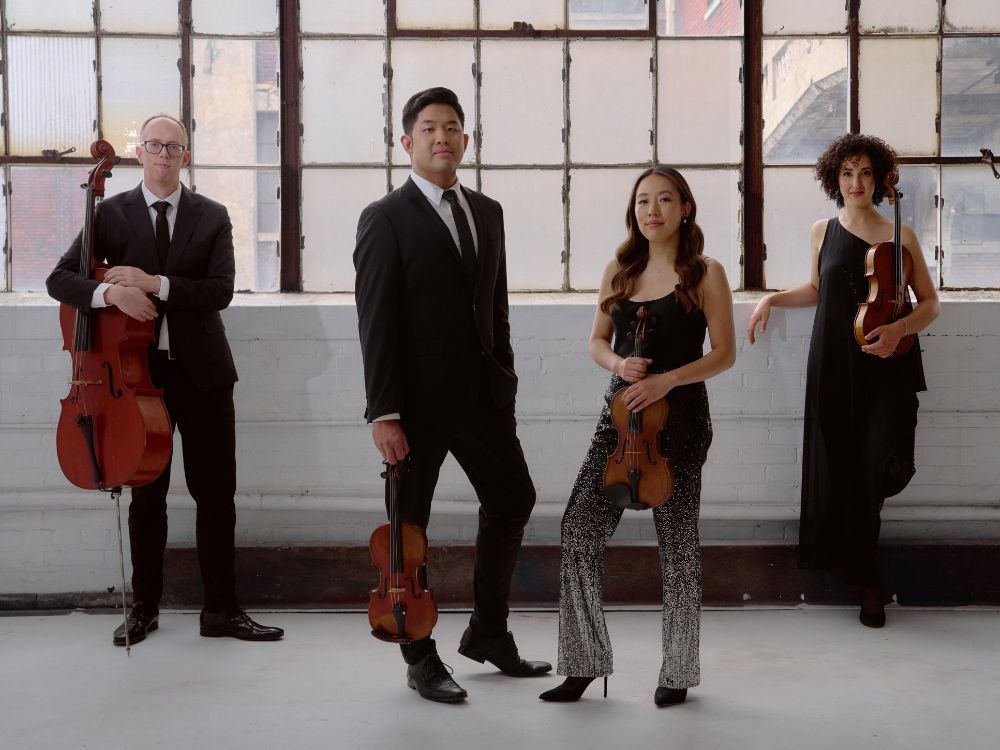
The recording uses a full string orchestra; at St. Andrew's-Wesley the choir is joined by the Microcosmos Quartet, percussion and harpist Janelle Nadeau. The programme also includes music by three Canadian composers, Iman Habibi, Andrew Balfour and Sarah Quartel. If you'd like to know the music first, the VOCES8 album runs about 45 minutes and is on every streaming service.